Running a Shopify store has always meant wearing too many hats — you’re the marketer, the customer service rep, the inventory manager, and the analyst, often all before lunch. The good news? In 2026, the automation tools available to store owners are better than ever, and you don’t need to be a developer to use most of them.
Let’s break down what’s working, what tools are worth your time, and the workflows that actually move the needle.
Why Shopify Automation Matters More Than Ever
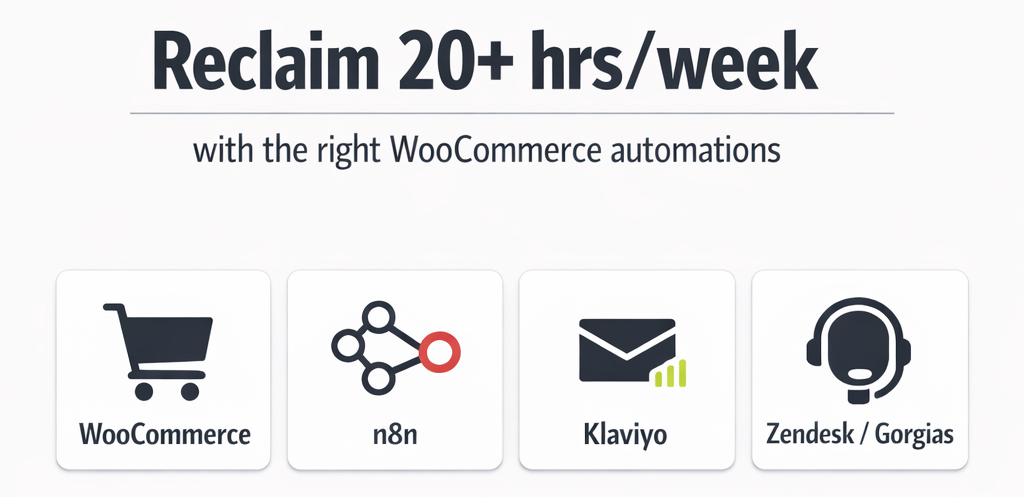
The math is simple: repetitive tasks eat time, and time is inventory you can’t restock. Merchants using Shopify Flow report saving 15–20 hours per week on routine operations Shopify — that’s half a full-time employee’s workweek, handed back to you every Monday.
But automation isn’t just about saving time. The real value is sending the right message at the right moment, and then getting out of the way so you can focus on growing the business instead of babysitting every campaign.
The Tools You Should Know
Shopify Flow (Built-in)
The most underused tool already sitting in your Shopify admin. Flow’s recent updates let you describe a workflow in plain language — something like “tag customers as VIP when they place an order over $200” — and an AI assistant builds the trigger, condition, and action for you in seconds.
A new test-run feature shows exactly what a workflow will do before you activate it, with each condition lighting up step-by-step using sample data — without touching real orders, customers, or inventory. Shopify That’s a big deal for anyone who’s ever accidentally sent a discount code to their entire customer list.
Best for: Store-level logic — tagging, fraud alerts, inventory notifications, internal team updates.
Klaviyo
Klaviyo is widely considered the gold standard for Shopify email and SMS automation. It integrates directly with Shopify’s backend, pulling customer behavior, purchase history, and browsing activity to create hyper-personalized campaigns. Its predictive analytics — including expected next order date and churn likelihood — set it apart from simpler email tools.
Best for: Stores doing $50K+/month that need serious segmentation and multichannel flows.
Omnisend
A strong Klaviyo alternative for stores that are still scaling. Omnisend handles email, SMS, and push notifications with a free tier up to 250 contacts and paid plans starting at $16/month for 500 contacts. According to Omnisend’s 2026 Ecommerce Marketing Report, welcome messages and abandoned cart flows together drove 76% of all automation orders in 2025.
Best for: Stores under $50K/month that want omnichannel without the complexity.
MESA
Think of it as Zapier, but designed specifically for Shopify. MESA lets you build workflows by simply talking to an AI assistant, while also offering drag-and-drop templates. It connects Shopify with Slack, Klaviyo, Google Sheets, and more — and workflows run 24/7 without manual intervention.
Best for: Merchants who want Zapier-style flexibility with Shopify-native context.
Zapier, Make, and n8n
These are the big three for connecting Shopify to the rest of your stack — CRMs, ERPs, accounting tools, Slack, you name it. Zapier leads with 7,000+ integrations and the simplest UX, Make delivers visual workflow power at roughly 60% lower cost than Zapier, and n8n is the only option with true self-hosting and unlimited executions.
The defining shift of 2025–2026 across all three has been AI integration — each now offers native connections to OpenAI, Anthropic, and Google Gemini, plus purpose-built AI agent workflow templates.
For store owners doing real volume, the cost difference gets significant. In one real-world comparison, a store averaging 3,000–6,000 order events per month ran up roughly $150–$400/month on Zapier, while the equivalent n8n self-hosted setup cost around $15 in infrastructure.
The catch with n8n: it’s built for people comfortable fiddling with APIs — you’ll deal with terms like API scopes, access tokens, and authentication methods, and the error messages when things go wrong aren’t always helpful. Eesel AI If you’re not technical, start with Zapier or Make.
Workflows Worth Building Right Now
Abandoned cart recovery — Still the highest-ROI automation in ecommerce. In 2025, abandoned cart emails hit a 39.46% conversion rate. A 30-minute delay after abandonment is a good balance between urgency and not being pushy.
Welcome series — Your first impression, automated. Welcome emails and abandoned cart flows combined drove 76% of all automation orders in 2025 Omnisend, so if you set up nothing else, set up these two.
VIP customer tagging — Use Shopify Flow or n8n to automatically tag customers based on lifetime value or order frequency, then feed those tags into Klaviyo for tiered campaigns.
Low-inventory alerts — Trigger a Slack notification or email to your team when stock on a key SKU drops below a threshold. Simple to build in Flow, five minutes of setup for hours of peace of mind.
Post-purchase review requests — After an order is fulfilled, you can trigger a review request email or SMS filtered by product category or purchase value, ensuring the right customers are asked at the right moment.
Order → accounting sync — Push new Shopify orders straight into Xero or QuickBooks via n8n, with logic for tax rules and discounts, so bookkeeping stays accurate without manual entry.
AI-powered product recommendations — Combine Shopify with AI models through n8n to suggest related products after purchase, delivered by email or chat to boost upsell and cross-sell.
Where to Start
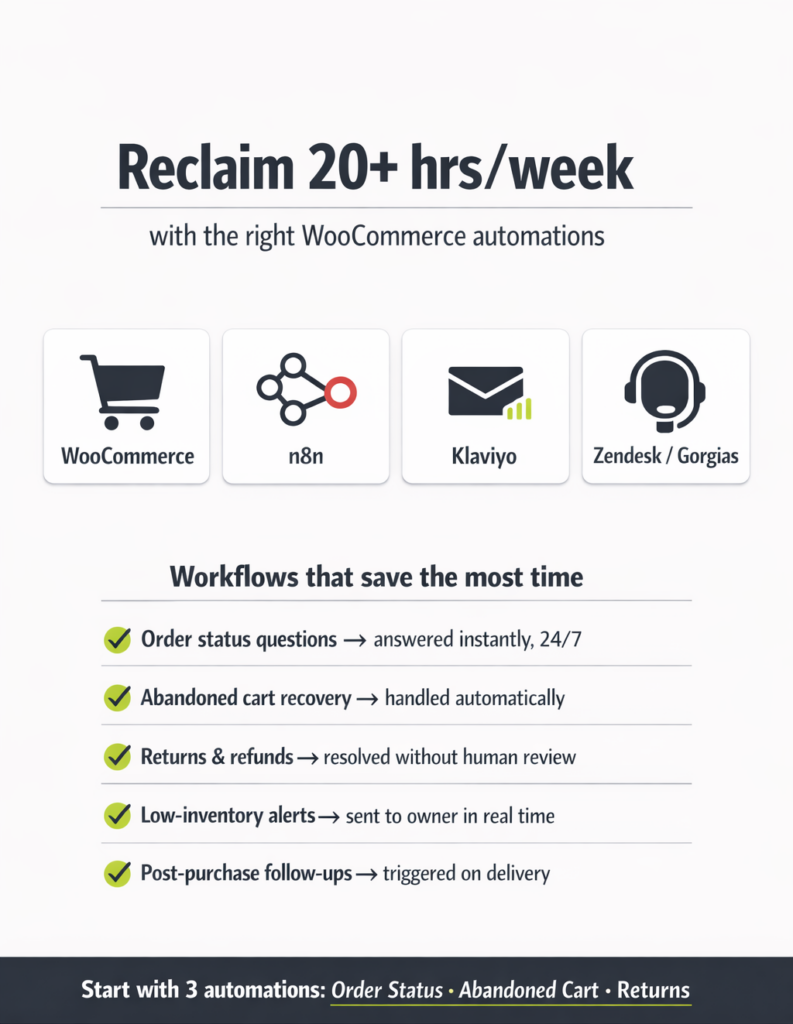
If automation feels overwhelming, start here: welcome series, abandoned cart, and a post-purchase follow-up. These three flows will teach you how your email tool’s workflow builder works and deliver the best-converting automations right from the start.
From there, layer in operational automations — inventory alerts, order syncs, team notifications — and eventually explore the more powerful connectors like n8n when your volume justifies the setup investment.
The stores winning in 2026 aren’t working harder. They’ve just gotten very good at letting their tools handle the predictable work while they focus on the decisions only a human can make.