Tools, Tactics, and Data-Capture Strategies That Actually Recover Revenue in 2026
Why Abandoned Carts Are Still Your Biggest Leak
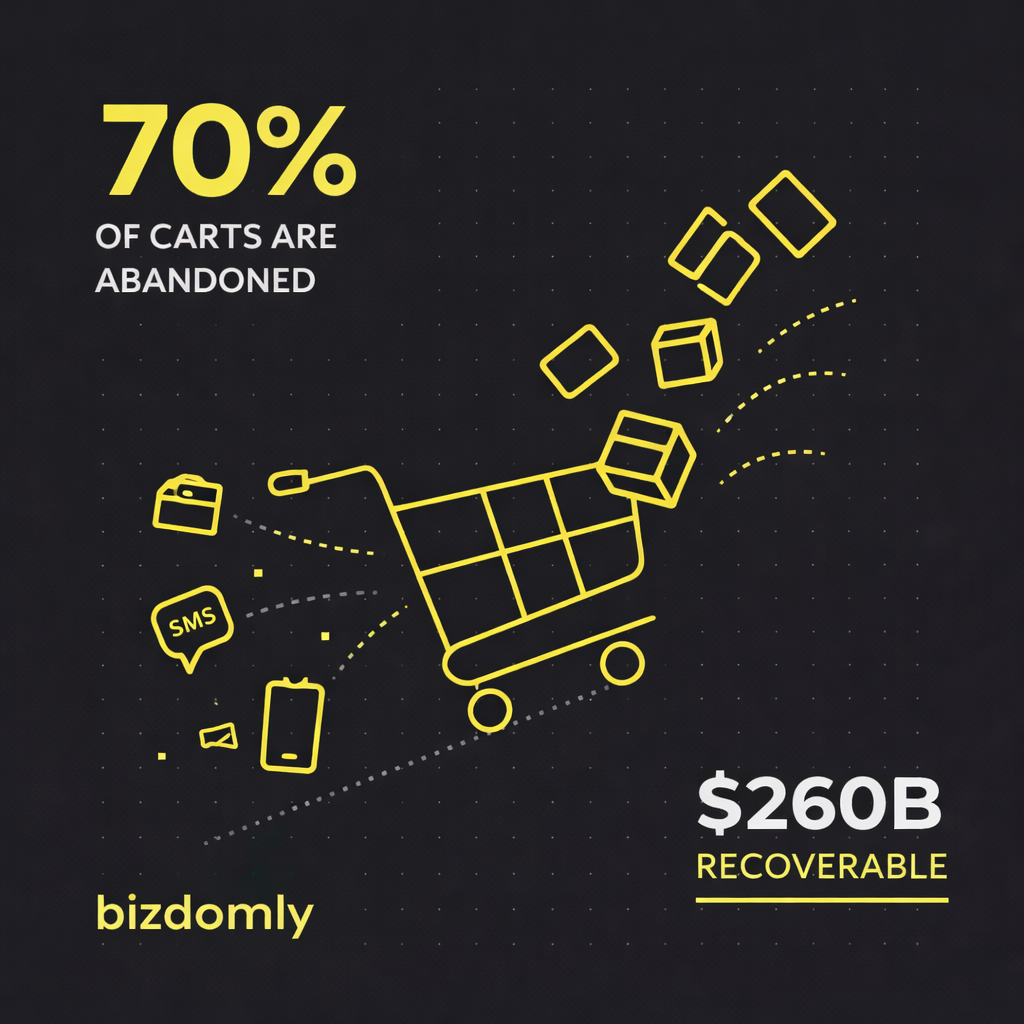
If you run an online store, abandoned carts are almost certainly the largest pool of lost revenue in your business. According to the Baymard Institute’s 2026 meta-analysis of 50 studies, the average documented online shopping cart abandonment rate is 70.22%. That number has barely moved in almost twenty years, which means seven out of every ten customers who add something to a cart on your site leave without paying.
The numbers get worse once you segment by device. Mobile abandonment hovers around 80%, while desktop sits closer to 66%. Fashion and travel lead the pack at around 84%, while grocery and pet care sit closer to 50–55%. Baymard estimates that in the US and EU alone, $260 billion is recoverable through smarter checkout design and better recovery flows.
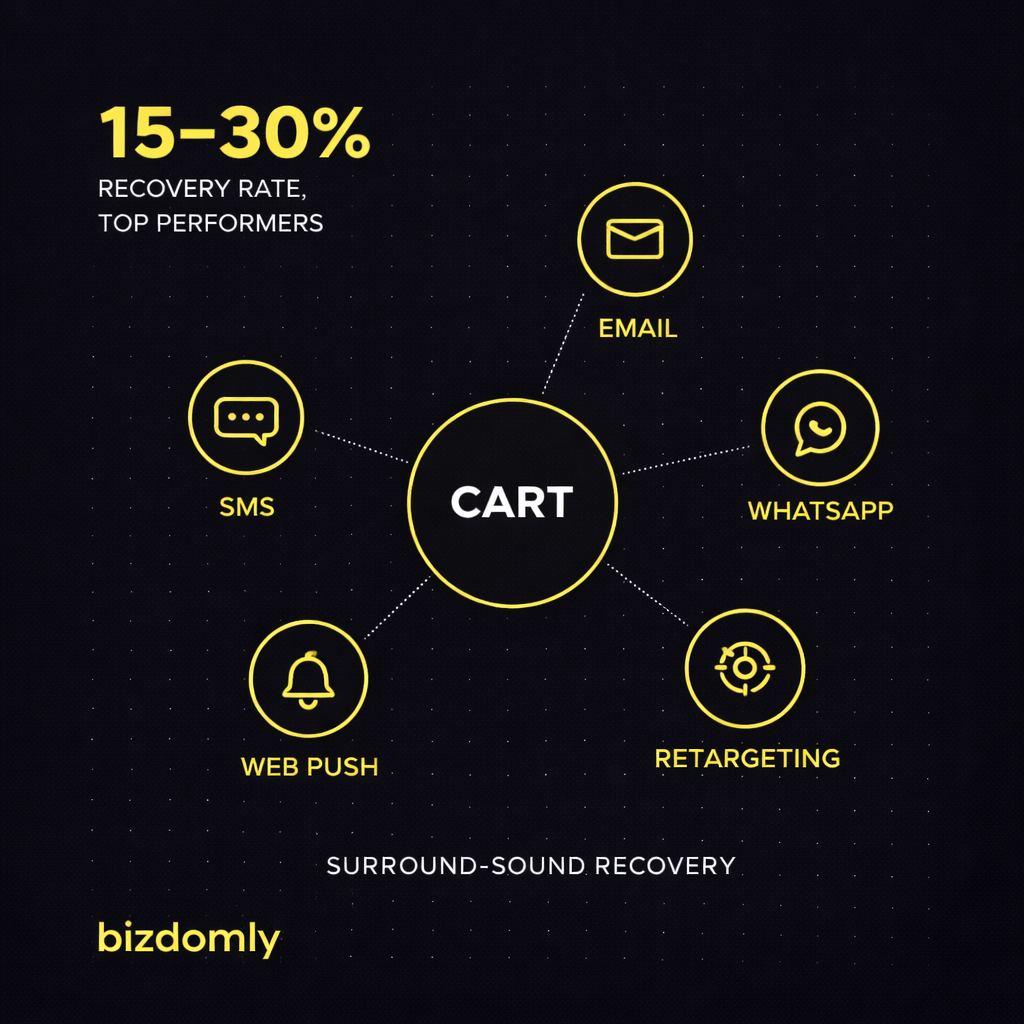
The encouraging half of the story: most stores only recover 3–5% of abandoned carts, but top performers who combine prevention, capture, and multi-channel follow-up routinely recover 15–30%. This guide is a tactical playbook for closing that gap. We’ll cover how to stop carts from being abandoned in the first place, how to capture the shopper’s contact data before they bounce, and how to build the recovery sequences that convert.
Why Shoppers Abandon: Know the Root Cause Before You Treat the Symptom
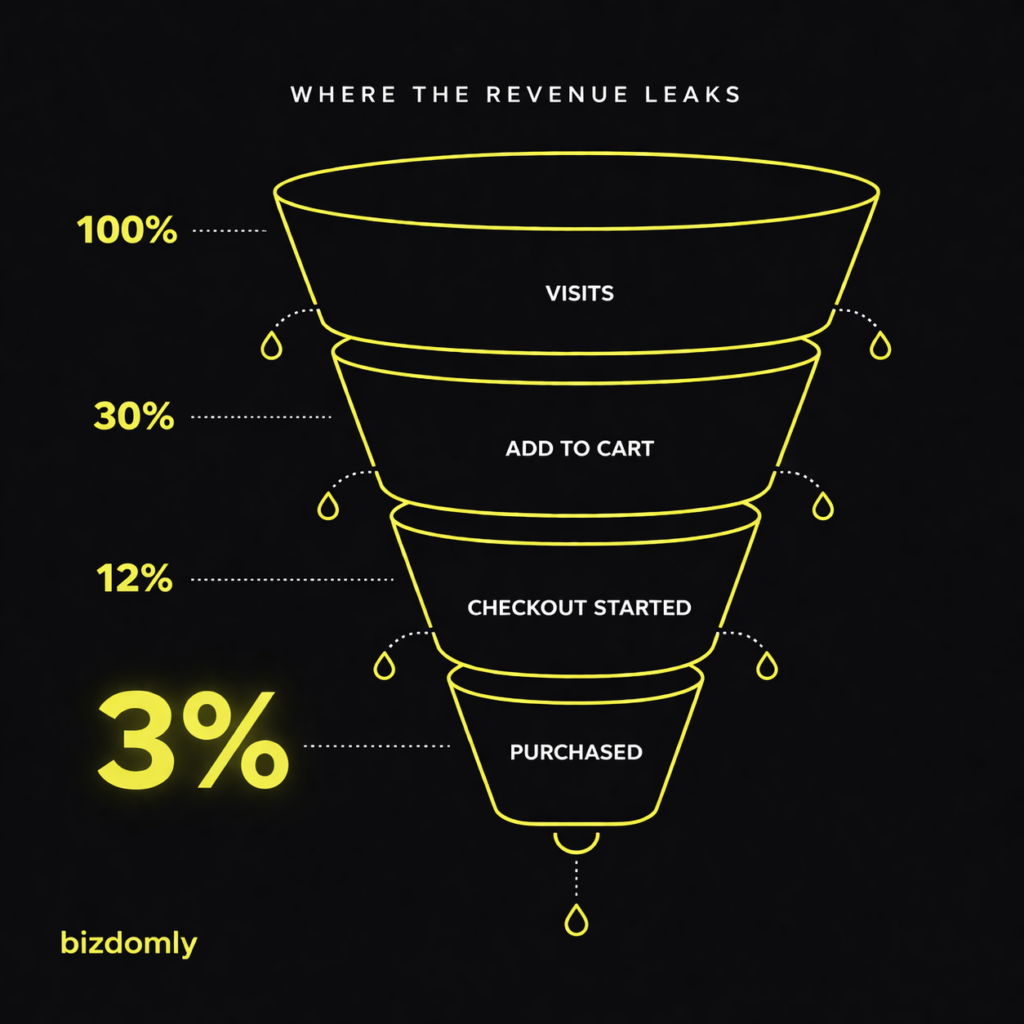
Before building recovery flows, audit the reasons that drive abandonment on your own store. Baymard’s 2026 data on shoppers who abandoned at checkout (excluding those just browsing) identifies a consistent hierarchy of friction points:
- Extra costs (shipping, taxes, fees) too high — 39%
- The site required account creation — 24%
- Delivery was too slow — 21%
- Didn’t trust the site with card info — 19%
- Checkout was too long or complicated — 18%
- Couldn’t see total cost upfront — 17%
- Returns policy unsatisfactory — 15%
Notice that most of these are preventable on the store side. Recovery emails are the last line of defense, not the first. The highest-ROI work usually happens in checkout, not in your ESP.
Layer 1: Prevent Abandonment Before It Happens
Show total cost early
Display shipping, taxes, and fees on the product page or cart drawer, not at step 3 of checkout. Use a ZIP-based shipping calculator or free-shipping thresholds tied to cart value. If a shipping fee is going to kill the sale, you want that decision made before the shopper has invested five minutes in form fields.
Offer guest checkout, always
Account creation is the #2 killer of conversions. Offer guest checkout by default and let shoppers “save their info” (i.e., create an account) after the purchase is complete, when the dopamine is on your side.
Collapse the checkout flow
One-page or accordion-style checkouts consistently outperform multi-step flows. Autofill the city/state from ZIP, default to the customer’s country, validate inline, and hide fields that aren’t needed (company name, middle name, second address line). Every field removed lifts conversion.
Add visible trust signals at the decision points
Payment logos, SSL badges, explicit returns/guarantee copy, and third-party reviews placed directly beside the “Place Order” button meaningfully reduce the 19% of abandonments caused by trust concerns. Short is better: “Free 30-day returns. No questions.” beats a wall of fine print.
Optimize ruthlessly for mobile
Given mobile’s ~80% abandonment rate, this is where the biggest wins are. Use Apple Pay, Google Pay, and Shop Pay as primary checkout options — they skip 10–15 form fields and authenticate biometrically. Stores that expose express wallets at the top of checkout regularly see 20–35% mobile conversion lifts.
Layer 2: Capture the Shopper’s Data Before They Leave
You can’t run a recovery sequence on a ghost. Every prevention win will still leave a large cohort of users who abandon, and the number one determinant of whether you can recover them is whether you have their email or phone. Here’s the tactical stack for capturing that data at every stage of the journey.
Capture on entry: welcome popups and spin-to-win
Show an entry popup after 10–20 seconds (or 30% scroll) on the first session, offering a 10–15% welcome discount in exchange for email and optionally phone. Exit-intent popups that offer a discount can convert up to 7% of abandoning visitors into subscribers. The email goes into your welcome flow; the phone opens up SMS recovery later.
Capture mid-funnel: email on add-to-cart
Add a “Save my cart” or “Email me this cart” option to the mini-cart drawer. Framing the ask as a benefit to the shopper (“so you don’t lose these items”) converts far better than a generic subscribe prompt. On Shopify, apps like Klaviyo, Omnisend, PushOwl, and Privy all support this pattern out of the box.
Capture at checkout: email-first checkout
This is the single highest-ROI capture tactic. Configure checkout so the email field is on step 1, before shipping and payment. Most major platforms (Shopify, BigCommerce, WooCommerce with plugins) now fire an “checkout started” event the moment that field is filled, even if the shopper never completes the order. That event is what powers your abandoned-checkout flow. Make the email field the first field on the page, pre-fetch it from browser autofill, and don’t hide it behind a “Continue as guest” click.
Capture SMS consent at checkout
Add a single checkbox under the phone field: “Text me order updates and exclusive offers (opt-in, reply STOP anytime)”. Combined with an existing phone field for shipping notifications, this is a compliant way to collect SMS subscribers. SMS consent at checkout typically converts at 20–40%, and those numbers drive the most valuable recovery channel you have.
Capture on exit: exit-intent with a real reason
The best exit-intent popups don’t just say “10% off!” — they reference what the shopper was doing. “Still thinking about the X? Here’s 10% to make it easier” converts dramatically better than a generic coupon. Trigger only after at least 30 seconds on site so you don’t nuke casual browsers, and never show it to users who have already subscribed.
Compliance: do this right or you’ll pay for it
Keep everything fully permission-based. Plain opt-in copy, no pre-checked boxes, a visible privacy policy link, and a one-click unsubscribe. GDPR, LGPD, and the US state privacy laws (CCPA, Colorado, Virginia, and others) all require explicit consent, and your ESP’s deliverability depends on clean lists. Cutting corners here costs you the inbox.
Layer 3: The Recovery Sequence That Actually Converts
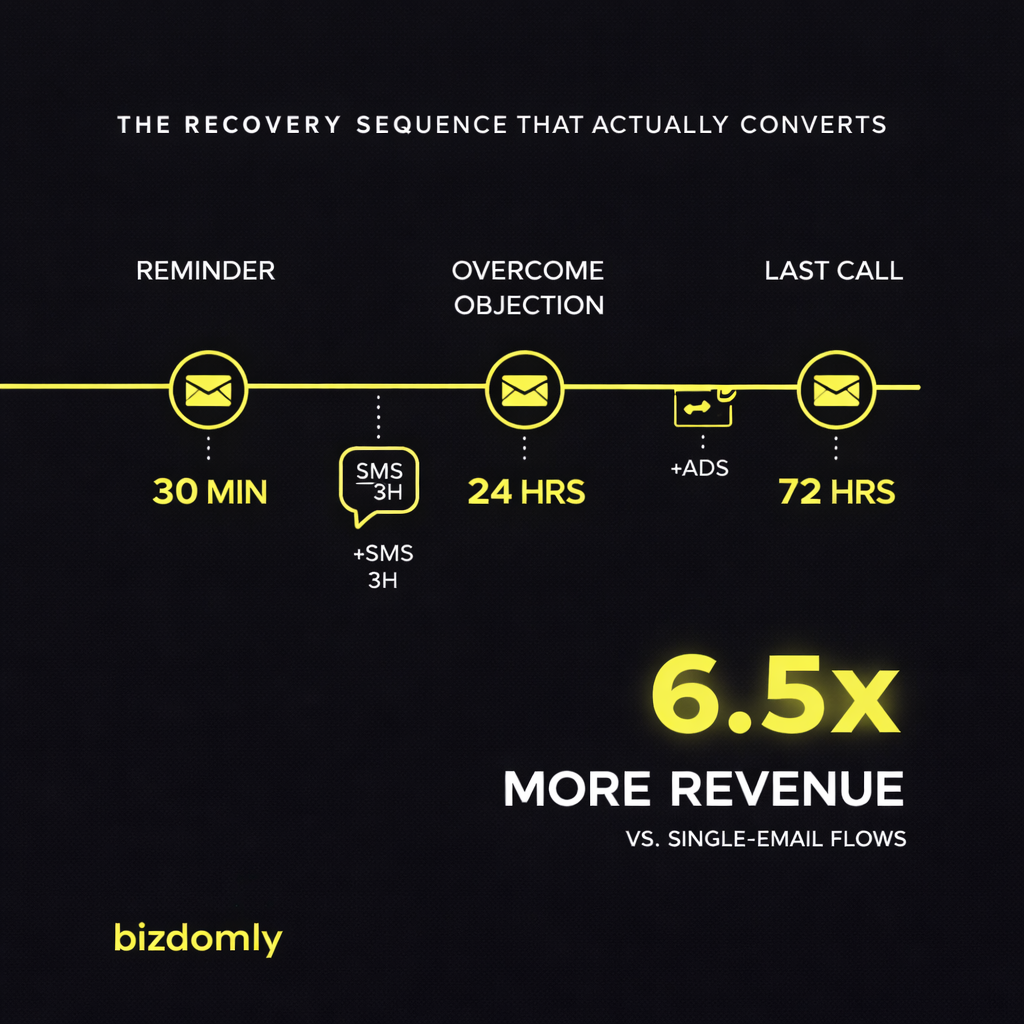
Once you’re capturing data, the recovery sequence becomes your workhorse. Three-email sequences outperform single emails by ~6.5x in revenue. Here’s the cadence that consistently wins:
| Touchpoint | Timing | Goal & Content |
|---|---|---|
| Email 1 | 30–60 min after abandonment | Reminder only. No discount. Show the cart, restate value, one-click “Return to Cart” button. Most recoveries happen here — don’t waste margin. |
| SMS 1 | 3–4 hours after | Short, casual, one-tap link back to the cart. “Hey [name], your cart is waiting — tap here to finish: [link]”. 90%+ open rates, response under 3 min. |
| Email 2 | ~24 hours after | Overcome objection: reviews, UGC, FAQ, returns policy, stock urgency (“only 3 left”), or social proof. Still no discount if you can help it. |
| Email 3 | ~72 hours after | Last call. This is where a discount or free-shipping offer comes in if margins allow. Add a real deadline (“expires tonight”) and a single CTA. |
| SMS 2 (optional) | Same day as Email 3 | Only for SMS-subscribed users. Mirrors Email 3’s offer with a shorter deadline. Stop after this — more than 3 touches burns the list. |
Benchmarks worth remembering: abandoned cart emails average a 44.76% open rate and a 10.7% conversion rate on recipients. Well-run SMS sequences convert 25–40% of recipients, dramatically higher than email. The combination (email for storytelling, SMS for urgency) is what separates a 5% recovery store from a 20% recovery store.
Content tactics that move the needle
- Personalize the subject line with the product name, not just “your cart”. “You left the behind” beats “Forget something?” every time.
- Show the product image large. Text-heavy recovery emails underperform.
- Use one dominant CTA button. Multiple CTAs dilute click-through.
- Include dynamic reviews or a star rating under the product — it handles the trust objection silently.
- Pre-fill the cart so the CTA opens a ready-to-pay checkout, not a product page. This can lift conversion 20–30% alone.
- Segment: higher AOV carts get a more polished, review-heavy flow; low-AOV carts get a faster, discount-forward flow.
Layer 4: Surround-Sound Recovery (Ads, Push, WhatsApp)
Retargeting ads
Meta, TikTok, and Google dynamic product ads can serve the exact items left in the cart within minutes of abandonment. Keep the retargeting window tight (1–7 days) and exclude converters. The goal isn’t to add incremental touches forever — it’s to reinforce Email 1 and SMS 1 within the first 24–48 hours when intent is highest.
Web push
Free, near-zero-friction, and opt-in. Shoppers who accept push notifications can be pinged the moment they abandon, while they’re still on-device. Conversion rates are lower than email, but so is the cost, and it reaches users who never gave you an email.
WhatsApp (regional must-have)
In Latin America, Southern Europe, India, Southeast Asia, and the Middle East, WhatsApp is the dominant conversational channel — often more than email. Tools like Mercuri, Wati, and Charles let you trigger abandoned-cart WhatsApp messages with media, product cards, and one-tap reply. Done well, WhatsApp cart recovery routinely beats email and SMS combined in these markets.
Tool Stack: What to Plug In
The landscape changes fast, but here’s the practical 2026 shortlist by job-to-be-done. Pick one per row, not one per column:
| Job-to-be-done | Strong options in 2026 |
|---|---|
| Email + SMS automation | Klaviyo (deep data, best for scaling DTC), Omnisend (best all-in-one for SMBs), Drip, Brevo, ActiveCampaign. |
| SMS-first / conversational | Attentive, Postscript, Emotive. Strong for US brands with real SMS subscriber bases. |
| WhatsApp commerce | Mercuri, Wati, Charles, Zoko. Essential for LATAM, EU, MENA, and APAC. |
| Popups & on-site capture | Privy, Justuno, OptiMonk, Wisepops, Klaviyo Forms (if already on Klaviyo). |
| Web push | PushOwl, OneSignal, Firepush. |
| Retargeting & dynamic ads | Native Meta/TikTok/Google catalog ads; AdRoll or Rokt for mid-market. |
| Checkout optimization | Shopify native, Bold Checkout, ReCharge (subscriptions), Shop Pay / Apple Pay / Google Pay. |
Heuristic: if you’re under $5M/year, pick one platform that covers email + SMS + popups (Omnisend or Klaviyo) and resist the urge to stitch three tools together. Complexity kills execution more often than the “wrong” tool does.
Measure What Matters: The Five KPIs to Watch
- Cart abandonment rate. Your baseline. Segment by device and by landing page.
- Email/SMS capture rate at checkout. The percentage of sessions that produce a usable contact before payment. This is the ceiling of what you can recover.
- Recovery rate. Of abandoned carts with a captured contact, what percentage converts within 7 days?
- Revenue per recipient (RPR). The cleanest measure of sequence quality across emails and SMS.
- Unsubscribe / STOP rate. The guardrail. If recovery revenue goes up but unsub rate triples, you’re borrowing from the future.
Set a quarterly test calendar: one checkout variable, one popup variable, one sequence variable per month. Small, additive tests compound into the 3–4x recovery lift that separates operators from hobbyists.
Mistakes We See Repeatedly
- Running only Email 1 and calling it a sequence. Single-email flows leave most of the money on the table.
- Leading with a discount. Shoppers learn the pattern and abandon on purpose. Train the opposite behavior: discount only on the last touch, if at all.
- Not cleaning the list. Suppress recent purchasers, subscribers already in a welcome flow, and inactive 90-day profiles to protect deliverability.
- Ignoring mobile checkout. Most recovery programs are tuned on desktop while 70–80% of sessions are mobile. Audit on a real phone, not Chrome dev tools.
- Over-messaging. More than three touches in 72 hours trains shoppers to ignore you.
- No attribution window discipline. Credit recoveries to the last touch within a defined window (e.g., 5 days); otherwise you’ll double-count.
A 30-Day Action Plan
Week 1 — Measure and fix the leaks
- Run a checkout audit on mobile. Time yourself. Every tap over 10 is a candidate for removal.
- Confirm total-cost visibility before checkout starts.
- Enable guest checkout and express wallets (Apple Pay, Google Pay, Shop Pay).
Week 2 — Capture
- Move the email field to the top of checkout so it fires “checkout started” early.
- Launch a welcome popup and an exit-intent popup with differentiated copy.
- Add an SMS consent checkbox under the phone field at checkout.
Week 3 — Recovery flows
- Build the 3-email sequence (30 min / 24 h / 72 h) with dynamic product blocks.
- Add two SMS touches (3 h and ~72 h) to the same flow, gated by consent.
- Turn on Meta and Google dynamic retargeting with a 7-day window.
Week 4 — Optimize
- A/B test subject lines, the lead image, and the presence of a discount on Email 3.
- Segment high-AOV vs low-AOV carts into two versions of the flow.
- Start a weekly dashboard tracking the five KPIs above.
Most stores that run this plan see their overall revenue climb 8–15% within one quarter without any additional ad spend. That’s what “free money” looks like in ecommerce.
Working With Us
At Bizdomly we build this entire stack end-to-end for ecommerce brands — checkout optimization, data capture, email/SMS/WhatsApp recovery flows, and the analytics layer to prove it’s working. If you’ve read this and realized your store is leaking in more than one place, that’s usually where our engagements start: an audit, a prioritized fix list, and the implementation that turns those 3% recoveries into 15–20%.
If you’d like a free 30-minute audit of your current cart recovery setup, reach out — we’ll tell you exactly where the biggest lift is, whether or not you end up working with us.