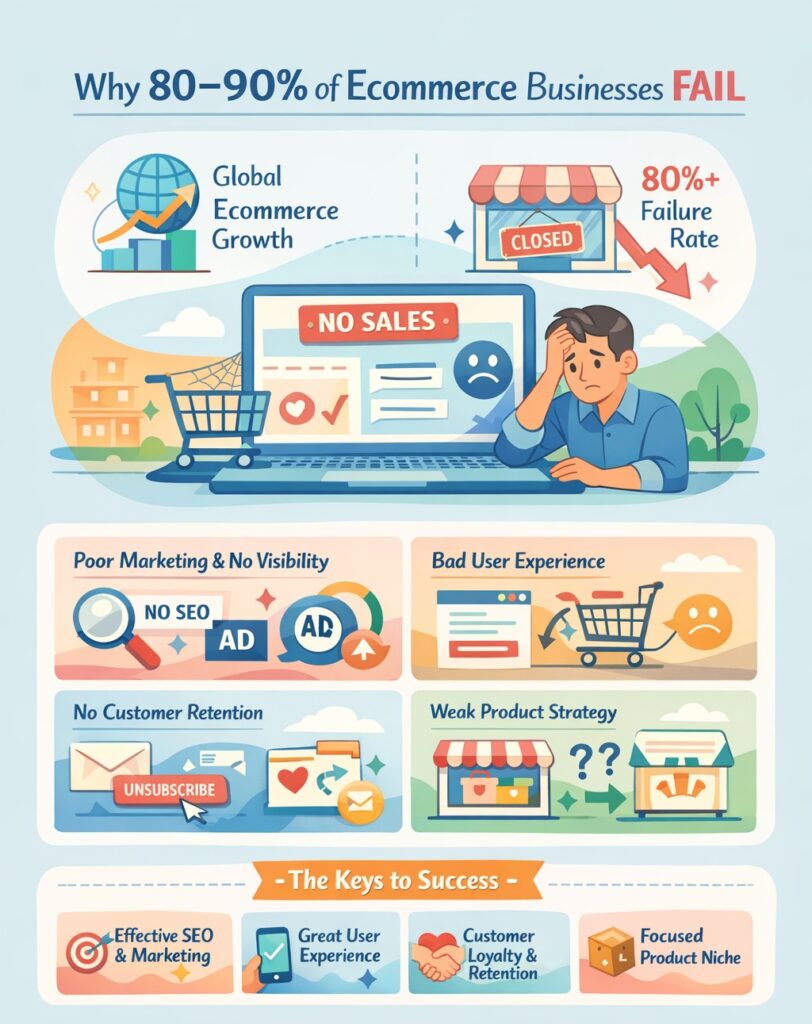
You’ve probably heard the stat: roughly 80–90% of ecommerce businesses fail. It’s a sobering number, especially when you consider how much the global ecommerce market continues to grow year after year. The demand is clearly there. So what’s going wrong?
After digging into the research — including a survey of over 1,200 failed ecommerce business owners — the answer isn’t what most people expect. It’s not that the market is too saturated or that Amazon has swallowed everything whole. The real reasons are far more fundamental, and far more preventable.
The Online Store Is Not a Passive Storefront
Here’s the mindset shift most ecommerce business owners miss: a physical store has a salesperson. Someone who greets the customer, reads their body language, answers questions, and adjusts their approach in real time.
An online store has none of that. Every aspect of rapport building, trust, and selling is mediated through a platform — through design, copy, navigation, and automated workflows. If you haven’t invested in optimizing those digital customer journeys, you essentially have a store with no salesperson, no signage, and the lights half off.
This is the root cause behind most of the specific reasons ecommerce businesses fail.
The Top Reasons Ecommerce Businesses Fail
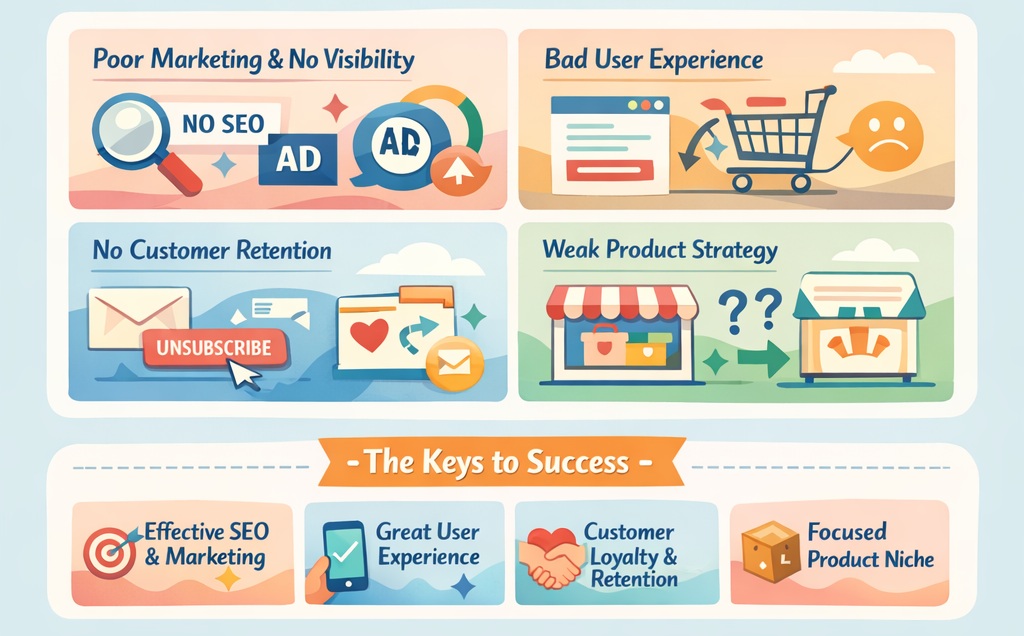
1. Poor Marketing and Zero Search Visibility
This is the number one killer. In a study of 1,253 failed ecommerce business owners, 37% cited poor online marketing and 35% pointed to a lack of search engine visibility as their primary reasons for failure.
It doesn’t matter how good your product is if nobody can find your store. Many ecommerce businesses either skip SEO entirely, dump their budget into short-term paid ads without a long-term content strategy, or spread themselves so thin across channels that nothing gains traction.
The fix isn’t complicated, but it does require consistency: invest in SEO from day one, build a content strategy around your niche, and track what’s actually driving revenue — not just traffic.
2. Terrible User Experience
A confusing layout, slow load times, cluttered navigation, and a painful checkout process will send customers straight to a competitor. And online, the next competitor is literally one click away.
This is even more damaging than it sounds because users associate the visual quality and usability of your site with the credibility of your business. A poorly designed store doesn’t just frustrate people — it makes them distrust you.
The basics matter: fast page loads, clean design, intuitive navigation, mobile responsiveness, and a checkout process that doesn’t feel like filing a tax return.
3. No Customer Retention Strategy
Most ecommerce businesses pour all their energy into acquiring new customers and completely neglect the ones they already have. This is a costly mistake.
Acquiring a new customer is significantly more expensive than retaining an existing one. Repeat customers spend more, refer others, and are far more profitable over time. Yet most stores have no follow-up emails, no loyalty programs, no personalized recommendations — nothing to bring people back after the first purchase.
If your entire business model depends on constantly finding new buyers, your customer acquisition costs will eventually eat you alive.
4. Weak Product Strategy
Trying to sell everything to everyone is a fast track to irrelevance. Many ecommerce stores look like unfocused marketplaces — electronics next to cosmetics next to pet supplies — with no clear identity or authority in any category.
The stores that succeed are the ones that go deep in a niche, understand their specific customer’s pain points, and position their products as the obvious solution. You don’t need to carry thousands of SKUs. You need the right ones, presented in a way that makes the value unmistakable.
5. Undercapitalization
Here’s a pattern that plays out constantly: a business owner will happily invest $50,000 or more into a physical storefront but refuse to spend $5,000 on their online store. Ecommerce gets treated as a side project — something that should just “work” with minimal investment.
The reality is that a serious ecommerce operation needs budget for platform and hosting, professional product photography, marketing and advertising, SEO and content, customer service infrastructure, and ongoing optimization. If you’ve dumped your entire budget into inventory and a website template with nothing left for marketing, you’ve built a store in the middle of a desert with no roads leading to it.
6. Inability to Differentiate
Competition is fierce. When dozens of stores sell the same products at similar prices, customers have no reason to choose you over anyone else. Yet many ecommerce businesses launch without a clear value proposition or any understanding of what their competitors are doing well — or doing poorly.
The winners in ecommerce aren’t always the ones with the lowest prices. They’re the ones who identify gaps in the market — whether that’s better customer service, a more curated selection, superior content, or a brand story that resonates — and exploit them relentlessly.
7. Ignoring Product Content
Weak product descriptions, low-quality photos, and a lack of video content are conversion killers. Over 90% of consumers read reviews before purchasing, and they rely heavily on product visuals and descriptions to make buying decisions.
If your product pages have one-sentence descriptions copied from the supplier and blurry photos taken on a phone, you’re leaving money on the table. Compelling product content — detailed descriptions, high-quality images, video demos, and authentic customer reviews — is what turns browsers into buyers.
The Cautionary Tale of Toys R Us
If you think size protects you, think again. Toys R Us was once the dominant toy retailer in America. When ecommerce emerged, they outsourced their entire online operation to Amazon rather than building their own digital customer experience.
By the time they tried to course-correct, it was too late. They had never learned to engage customers digitally, never built the infrastructure for online rapport, and were ultimately destroyed by the very company they had handed their customers to.
The lesson: no matter how established your business is, treating ecommerce as an afterthought is a recipe for failure.
What the Successful 10% Do Differently
The ecommerce businesses that survive and thrive aren’t doing anything magical. They’re doing the fundamentals well and consistently:
They treat their online store as an active sales channel, not a digital brochure. They invest in SEO and content marketing for sustainable, long-term traffic. They obsess over user experience and continually optimize based on data. They build relationships with customers beyond the first transaction. They go deep in a niche rather than trying to be everything to everyone. They invest real money and real time, treating ecommerce as a legitimate business — not a side hustle.
The 80–90% failure rate isn’t a death sentence. It’s a reflection of how many people underestimate what it takes to run a successful online business. If you’re willing to invest in the fundamentals and play the long game, the odds shift dramatically in your favor.
Running an ecommerce business and feeling the pressure of these challenges? At Bizdomly, we specialize in building ecommerce solutions that are designed to convert — not just exist. Get in touch to talk about how we can help your store beat the odds.